
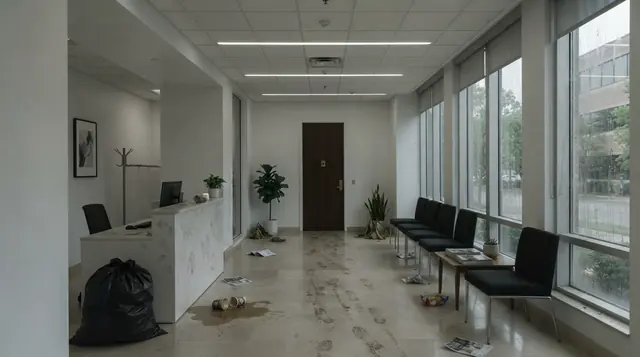
Chicago winter road salt and your office floors
Why road salt leaves a white film on office floors and carpet, and how mats, quick wiping and a neutral cleaner keep it under control.
Every Chicago office manager knows the look by January. A pale, chalky film across the lobby tile, gritty patches on the carpet near the door, and boot prints that come back an hour after they were mopped. It is road salt, and it travels much farther into your building than you would expect.
What the white film actually is
Cities and property owners spread salt on roads and walks to melt ice. Shoes pick up salty slush, carry it inside, and the water evaporates. The water leaves, the salt stays. What you see is a thin layer of dried salt crystals, often mixed with fine grit and dirt from the street.
Why salt is hard on floors and carpet
Salt does damage in a few quiet ways.
- Grit that scratches. Dried crystals and sand act like sandpaper under every footstep. On hard floors they dull the finish. In carpet they work down into the fibers and wear them from the inside.
- Residue that holds dirt. A salty film is sticky on a microscopic level. Dirt clings to it, so floors look dirty faster.
- Stains on carpet. White tide lines form where wet carpet dries. They can be stubborn if the salt is left to build up for weeks.
- Slip risk. Wet tile near an entrance is slippery, and salty slush makes puddles that people do not notice until they step in them.
Start at the door: mats and quick wiping
The cheapest way to protect a floor is to keep salt from reaching it. A good setup uses two kinds of mat.
- Outside, a scraper mat. Coarse and rugged, it knocks the heavy slush and grit off the soles.
- Inside, an absorbent mat. It soaks up the moisture and the fine salt that is left.
Length matters more than most people think. A small doormat only gets one or two steps. You want a run long enough that each foot lands on it several times before reaching the floor. Keep mats flat, and vacuum or swap them often, because a mat full of salt hands it back to the next pair of shoes.
Wipe up slush as it appears and put out a wet floor sign while the area is damp. Standing slush is far easier to remove than dried salt.
Why a neutral cleaner, not just more water
It is tempting to flood the problem with plain water. Water does dissolve salt, but a heavy wet mop mostly spreads the salty water around. When it dries, the salt is back, just in a different place. On carpet, too much water can soak into the backing and dry slowly.
A neutral cleaner is a better tool for ordinary salt film. It is mild enough for most finished floors, it lifts the film along with the dirt that is stuck to it, and it does not leave a harsh residue of its own. Follow the label on dilution, because too much cleaner leaves a sticky layer too. Change the mop water often. Grey, salty water in the bucket means you are putting salt back on the floor.
For carpet, vacuum first and often, since dry grit is the real enemy. Then use a cleaning method that matches the carpet maker's guidance rather than soaking the area.
Where a professional team makes the difference
Salt control is a routine, not a one-off job, and that is where a professional team helps most. A good crew brings the right tools and schedule: vacuuming grit before it is ground into carpet, using the right method for each floor type, and changing mop water so salt is lifted away, not spread around. It keeps that pace through the whole season, on bad slush days as well as good ones.
A professional team can also tell you what it sees. It notices the worn path, the tide lines or a floor finish wearing through, and says so early, while the fix is still small. Ask any company you hire how it handles winter floors, and what it does when the film comes back.
When to call for a deeper floor clean
Routine cleaning handles the daily load. Signs that it is time for something more:
- The white film returns within a day of mopping.
- Carpet near the entrance looks dull, stiff or gritty even after vacuuming.
- Hard floors look cloudy and the finish is wearing through in the walking path.
- You can see tide lines or salt rings on carpet.
Our deep clean starts at $450 for up to 1,500 sq ft, and a 50% deposit holds the date of your first deep clean. You can see what a Chicago winter routine looks like on our winter floors section, and how to arrange a walkthrough on the same site.
The short version
- The white film is dried road salt and grit. It scratches, holds dirt and stains carpet.
- Use a scraper mat outside and an absorbent mat inside, long enough for several steps.
- Wipe slush early, and use a neutral cleaner with clean mop water instead of just more water.
- If the film keeps coming back, it is time for a deeper floor clean.